


Why Intelligent Workforce Planning Makes All the Difference
Businesses dealing with fluctuating demand, seasonal peaks, and location-specific requirements need more than basic headcount targets. They need intelligent workforce planning — one that brings together historical data, current guidelines, regional events, and available staff resources within a single, seamless process.
Effective demand planning must operate across multiple layers simultaneously: carrying forward historical figures into the planning year, accounting for public holidays, promotional periods, and special opening hours, deriving realistic hour budgets, and distributing staffing requirements across the day. It is precisely this combination of annual planning, demand-driven scheduling, and controlling that transforms workforce planning into a true management tool.
The greatest value is unlocked when demand planning is not treated in isolation, but used as a reliable foundation for financial performance, service quality, and operational scheduling. This makes it immediately visible when understaffing is imminent, where budget headroom exists, and how hours can be deployed where they deliver the greatest impact.
This is where SEAK Workforce Planning comes in: historical figures, events, and productivity targets converge in a single planning logic — all the way through to concrete staffing at every hour of the day.
Data-Driven
Revenue, frequency, productivity, and historical data are seamlessly incorporated into demand planning in a structured, systematic way.
Intelligent
SEAK automatically generates demand forecasts based on historical patterns and seasonal trends — giving your team the insights they need to make confident, informed decisions.
Event-Aware
Public holidays, special shopping Sundays, promotions, and inventory counts are all centrally factored into planning — including lead and lag time.
Cost-Effective
Hour budgets are derived from revenue expectations, productivity targets, and available capacity—giving your team full transparency at every step.
Flexible
Plan values can be adjusted as a percentage or absolute amount at the annual, monthly, weekly, or daily level.
Scalable
Multiple locations, planning zones, and branch structures can be mapped with their own calendars and individual parameters.
The Trade Trusts SEAK
From retail chains and bakery franchises to service providers and cinema operators: multi-site businesses across Germany rely on SEAK to manage their workforce.
Features of SEAK Workforce Planning at a Glance
Effective workforce demand planning balances analytical depth with real-world usability. What matters is turning data, targets, and events into concrete, manageable staffing requirements — transparent and traceable down to the day.
Succession Planning
Historical revenue data is seamlessly imported, mapped to the planning year, and used as a reliable baseline for all further planning activities.
Forecast Adjustment
Plan values can be adjusted as a percentage or absolute amount at the annual, monthly, weekly, or daily level.
Events Calendar
Public holidays, special trading hours, promotions, stock takes, and other exceptional events are managed and assigned from a single central location.
Daily Schedule Framework
Volume classes and distribution types help you clearly distinguish between high- and low-performing days — and evaluate them accordingly.
Time Budgets
Available hours are accurately reflected based on workforce data and planned absences.
Hour Budgets
Hour budgets by volume class and day type are derived from revenue expectations, productivity targets, and staff availability.
Staffing Densities
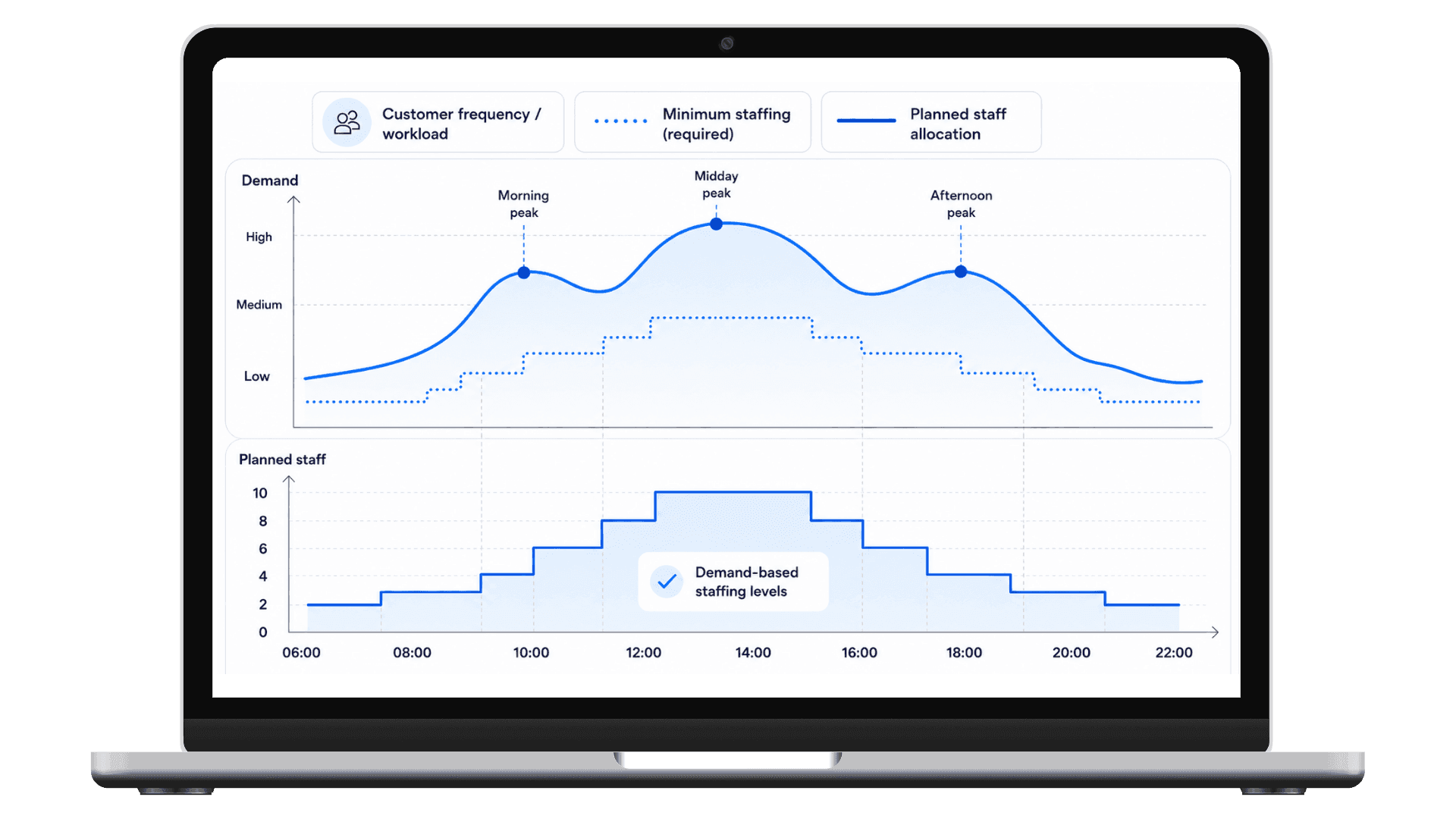
The available hour budget is distributed across the day — factoring in shift intervals, minimum staffing requirements, module lengths, and break logic.
Qualification Requirements Profiles
Define qualification and role requirements by day type, shift, or task area — the foundation for accurate skills matching in your scheduling workflow.
Budget and Tolerance Control
Planned and actual budgets are displayed with full transparency, including tolerances for over- and underspend.
System Integration
Data from your ERP and point-of-sale systems can be leveraged as the foundation for planning, forecasting, and analysis.
Intelligent Workforce Planning for Retail and Adjacent Industries
Demand planning is relevant wherever staffing needs are dynamic — shaped by workload, time of day, seasonal patterns, and specific events. The solution is therefore designed to work across a wide range of organizational structures and industries.

Retail and Multi-Location Businesses

Bakeries

Service

Cinema Operations
Schedule a Free Consultation
We'd love to walk you through your options in a personal online meeting via Zoom and help you find the ideal workforce management solution for your business. Simply pick a time that works for you — your Zoom link will be sent to you by email.
Alternatively, you're welcome to reach out via our contact form — we'll get back to you promptly. Or give us a call at: +49 40 238 348 – 000
Frequently Asked Questions About Workforce Planning
What Is Workforce Planning?
Workforce demand planning determines how many employees, with which qualifications, are needed at any given time to keep operations running efficiently and maintain service levels. It is driven by business objectives, workload forecasts, scheduled events, and available resources.
What Is the Difference Between Workforce Demand Planning and Workforce Scheduling?
Workforce demand planning strategically determines how many hours are needed and when. Workforce scheduling then translates those requirements into concrete shifts and assignments at the operational level. The two are inherently connected — demand planning always comes first.
How Is Staffing Demand Determined in Retail?
In retail, revenue targets, customer footfall, productivity goals, opening hours, promotions, and special trading days are all critical drivers. These factors feed directly into staffing hour budgets and coverage requirements — ideally broken down to an hourly level throughout the day.
What data is used for demand planning?
Typical inputs include historical sales data, events such as public holidays or promotions, productivity targets, and the actual available hours of your workforce. Depending on the use case, customer counts, unit volumes, or foot traffic data can also serve as demand drivers.
Can the planning be adapted to special days and promotions?
Yes. Event calendars allow you to account for holidays, special shopping Sundays, promotions, inventory counts, and other planning-relevant dates — including lead and lag time.
How does annual planning translate into concrete staffing decisions?
Based on day types, hour budgets, and staffing densities, the available budget is distributed across the course of the day — creating a solid foundation for downstream workforce scheduling.
Is the solution suitable for multiple branches or planning zones?
Yes. Branch-specific calendars, different planning zones, and location-based planning logic are all fully supported — making demand planning viable even in complex, multi-site organizational structures.
How Does Workforce Planning Support Controlling?
Planned and actual budgets, tolerances, and variances are displayed with complete transparency. This gives finance controllers and leadership teams early visibility into where understaffing risks are emerging, where budget reserves exist, and where productivity targets are falling short.