


Why Smart Scheduling Makes All the Difference
Operational workforce planning in many organizations is shaped by conflicting demands. Staff must be deployed cost-effectively, while availability, qualifications, legal requirements, company policies, and individual preferences all need to be taken into account. Without digital support, this translates into high manual effort, limited transparency, and an increased risk of planning errors.
A modern solution must therefore do far more than simply assign shifts. It needs to convert staffing requirements into concrete schedules in a structured way, actively assist planners, surface rule violations early, and accurately reflect last-minute changes. Equally important is the ability to meaningfully involve employees and make planning decisions transparent and traceable.
Modern workforce scheduling therefore brings together automation, interactive planning support, and mobile accessibility within a seamless end-to-end process. The result: robust, fair, and cost-efficient schedules that can be adapted quickly to the demands of day-to-day operations.
Automated
Blank shift schedules are generated at the click of a button — significantly reducing manual planning effort.
Compliant
Statutory, contractual, and company-specific rules are validated in real time during the scheduling process.
Intelligent
Qualifications, availability, and preferences are matched to shift suggestions — you make the final call.
Mobile
Plan and adjust from anywhere — on PC, tablet, or smartphone, no fixed workstation required.
Transparent
Balances, planned positions, and the impact of changes remain visible throughout the planning process.
Responsive
When absences occur, a multi-level substitute search spans roles, departments, and locations to keep operations running smoothly.
The Trade Trusts SEAK
From retail chains and bakery franchises to service providers and cinema operators: multi-site businesses across Germany rely on SEAK to manage their workforce.
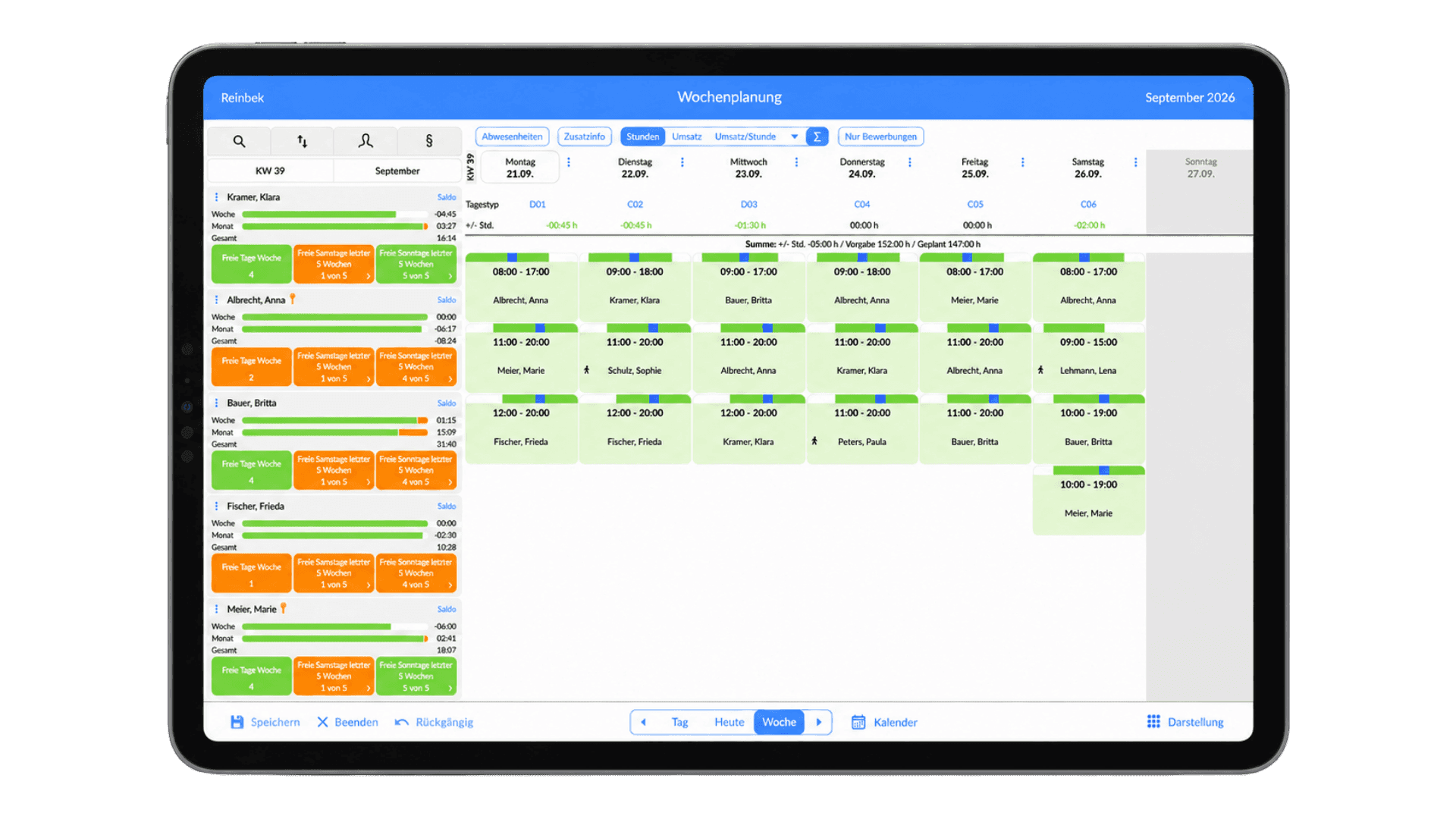
Features of SEAK Workforce Scheduling at a Glance
Modern workforce scheduling software — or shift planning tools in the broader sense — does much more than just build shift schedules. It enhances overall operational control by combining automation, transparency, regulatory compliance, and the agility to respond quickly when things change.
Automated Scheduling
Empty shift schedules are generated instantly for defined time periods, departments, or organizational units — providing a solid foundation for detailed planning.
Qualification Match
Shift requirements are automatically matched against each employee's stored qualifications — and the right people are suggested in the scheduling plan.
Interactive Suggestions
Relevant suggestions for shifts and employees are surfaced automatically, enabling planners to make faster, more informed decisions.
Real-Time Rule Validation
Changes are validated instantly against legal, operational, and individual requirements — errors are flagged during planning, before they become problems.
Mobile Planning
Accessible on PC, tablet, and smartphone, the planning tool keeps leaders productive wherever they work—no fixed desk required.
Employee Equity
Employee preferences, time-off requests, shift applications, and swap requests can all be systematically incorporated into the scheduling process.
Replacement Search
When unexpected absences occur, a multi-level search — within your own department and across locations — helps you fill shifts quickly and efficiently.
Real-Time Visibility
Balances, planned headcounts, and the impact of changes remain visible throughout the planning process, simplifying operational control.
Publication Workflow
Draft plans and published schedules are kept strictly separate — any changes made after publication are proactively communicated.
Role and Permission Management
Visibility and access permissions can be configured granularly by role and planning period.
Intelligent Workforce Scheduling for Retail and Adjacent Industries
Wherever staff scheduling demands flexibility, cost-efficiency, and compliance, intelligent digital workforce management delivers a tangible difference. The solution is designed for organizations of all types that face recurring planning cycles, fluctuating workloads, and the need to adapt at short notice.

Retail and Multi-Location Businesses

Professional Services

Bakery Chains

Cinema Operations
Schedule a Free Consultation
We'd love to walk you through your options in a personal online meeting via Zoom and help you find the ideal workforce management solution for your business. Simply pick a time that works for you — your Zoom link will be sent to you by email.
Alternatively, you're welcome to reach out via our contact form — we'll get back to you promptly. Or give us a call at: +49 40 238 348 – 000
Frequently Asked Questions About Workforce Scheduling
What Is Workforce Scheduling?
Staff scheduling distributes employees across shifts, time slots, and departments based on actual demand — transparently and in full compliance with applicable rules. It replaces manual planning steps with structured, auditable processes, and serves as the operational execution of upstream workforce demand planning.
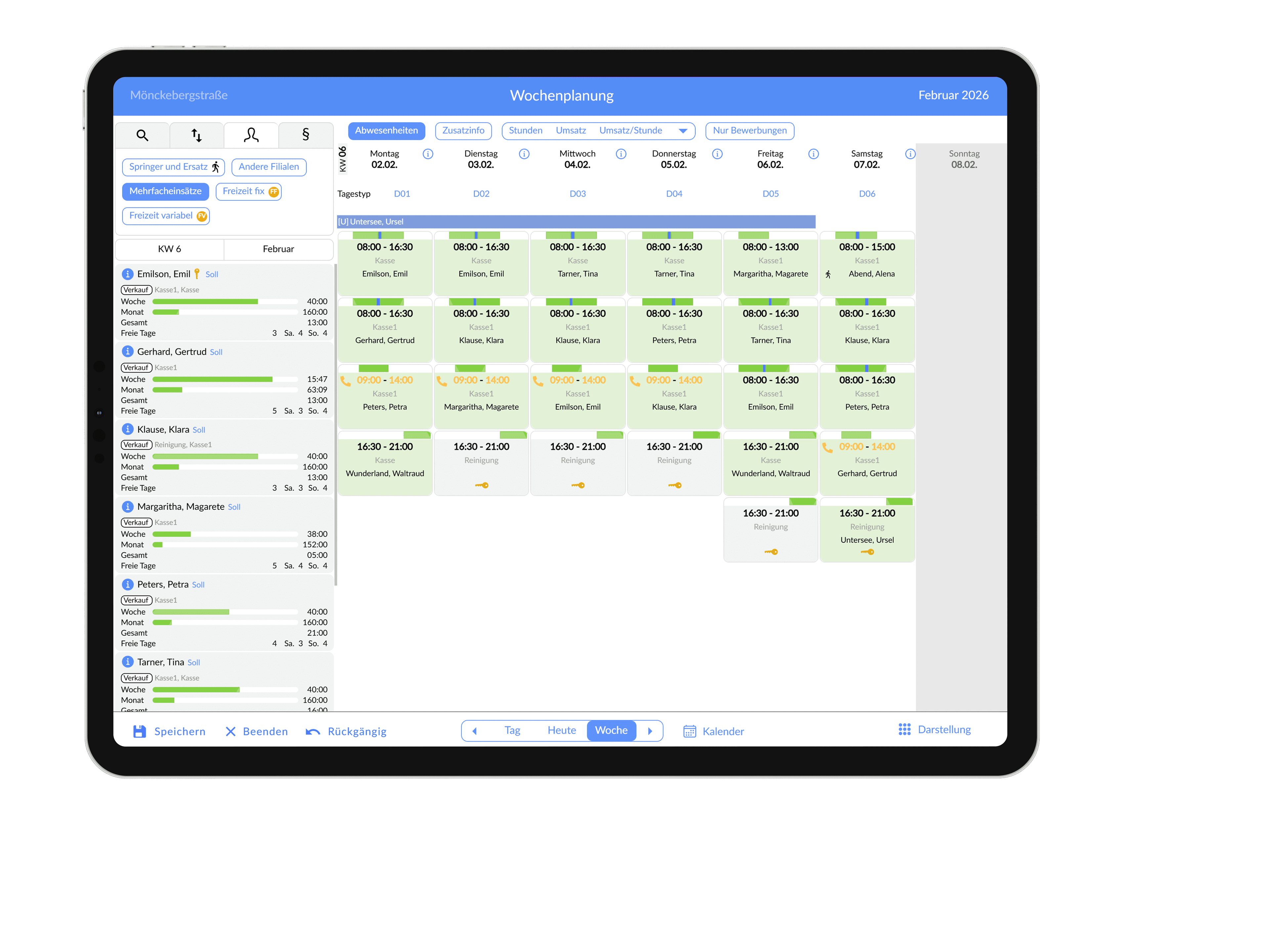
What's the difference between workforce scheduling and shift planning?
Shift scheduling refers to the creation and management of individual shifts. Workforce planning is the broader process: it connects shift creation with compliance rules, employee availability, qualifications, preferences, shift coverage, and publishing — all within a single system.
How Does Workforce Scheduling Software Help with Regulatory Compliance?
Schedule changes are validated in real time against legal, contractual, operational, and individual requirements. Violations are flagged early and displayed transparently — with role-based permissions allowing for defined exception handling where needed.
Which businesses benefit from workforce scheduling software?
It's the ideal solution for businesses running shift operations, managing multiple locations, or dealing with fluctuating staffing needs — typically retail, franchise chains, logistics, service industries, and other workforce-intensive environments. Especially relevant wherever availability, qualifications, and scheduling rules need to come together seamlessly.
Can the solution involve employees in the planning process?
Yes. Employee preferences, time-off requests, shift applications, and swap requests can all be incorporated into the scheduling process. This increases transparency and drives greater acceptance of shift plans across the team.
How do you create a shift schedule quickly?
Automated scheduling generates blank shift plans at the click of a button for defined time periods and departments. Interactive suggestions then surface the most suitable employees — significantly speeding up the fine-tuning process.
What happens in the event of short-notice cancellations?
When absences occur, a multi-level substitute search kicks in automatically. Available employees — whether unscheduled, free, or based at another location — are suggested based on matching qualifications, so you can fill shifts faster and with confidence.
Is the shift scheduling tool available on mobile?
Yes. The platform is fully optimized for PC, tablet, and smartphone – so you can plan and make adjustments on the go, from any device.